

Compare product rentals across India by the full cost, usable rental period and return terms. Use a renter-side checklist before deciding to rent or buy.
A laptop for a short project, speakers for an event and furniture for a temporary home solve different problems. They still raise the same buying question: do you need to own the product, or do you need access to it for a defined period? An online product rental marketplace helps you explore the second option. The decision becomes clearer when you compare the complete arrangement rather than the smallest price on a listing.
This guide is for renters across India. It focuses on comparing a rental with your actual need and with buying, not on promising that renting always saves money. RNTOUT is a multi-category rental marketplace, so the starting point is the product you need, your location and your dates. A national audience does not mean every listed item is available at every address. Confirm the specific arrangement before paying.
Write down the product specification, usable dates, delivery location, included accessories and the full non-refundable cost. Keep any refundable deposit separate, but include it when deciding how much money you need upfront. Then check the return arrangement and what happens if your plans change. Compare buying over the same period, including the practical question of what you will do with the item afterwards.
Start at https://www.rntout.com/ and choose the relevant category. Do not treat a broad category match as confirmation that a particular model, duration or delivery service is included.
A listing can be cheaper and still be wrong for the task. For a project laptop, write down the software requirements you need to meet, the required accessories and the period of use. For an event, record the quantities, venue access window and whether setup is needed. For a temporary home, check the dimensions and access restrictions before comparing furniture or appliances.
Keep this brief specific enough to send to more than one provider without changing it. That makes the replies comparable. Ask whether photographs show the item offered or are only representative. If an exact model matters, record it in the confirmation. If a substitute is proposed, compare it with the original need before accepting.
RNTOUT's catalogue includes categories such as electronics, IT infrastructure, furniture, vehicles, sports, medical equipment and event items. These are different rental decisions, not interchangeable products. This article does not establish suitability for a medical need or authorisation to use a vehicle. Those require the relevant qualified advice and product-specific checks.
The useful rental period is the time the product must actually be ready for you to use. That may differ from the time a van reaches the building or a collection is arranged. An event item arriving after setup begins is not equivalent to an item ready before the venue opens. A work device needing configuration may not be usable as soon as it arrives.
Give the provider both the required start and the required finish. Ask when billing begins, when the item must be returned and whether collection is included in that window. If you need installation or a demonstration, confirm whether it is part of the arrangement rather than assuming it follows from delivery.
For a longer rental, ask how an extension would be priced and approved. An available monthly listing does not automatically establish that you can keep extending it indefinitely. Keep the agreed dates together with the product details.
Record the quoted rent for your selected period. Add any confirmed mandatory delivery, collection, installation, service or other charges. Ask whether applicable taxes are already included. If a charge is not clear, mark it as unresolved instead of treating it as zero.
Keep optional additions on a separate line. An accessory or service may be useful, but it should not disappear into a headline price comparison. Also distinguish charges that definitely apply from charges that depend on a later event, such as extending the rental or returning an item late.
A practical record can use these lines:
Product and quantity
Agreed dates and billing period
Rent for that period
Mandatory charges and tax treatment
Optional additions selected
Refundable deposit, if applicable
Conditions that could create another charge
Delivery and return arrangements
This is a quote-checking framework, not RNTOUT's published fee schedule. Use the current listing and written confirmation for actual amounts. Save the version you relied on so a later price or availability change does not blur what you agreed.
A refundable deposit and a rental charge answer different questions. The rent is payment for use. A deposit may be money held under stated conditions. Even if it is refundable, it can affect whether you can afford the booking today.
Ask what amount applies to this item, who holds it, what starts the refund process and what conditions can lead to deductions. Record any stated refund timing rather than guessing. Do not assume all items on a multi-category marketplace use the same deposit arrangement.
Keep two views of the decision: the expected non-refundable cost if the agreed rental ends normally, and the total money needed before you can use the product. If a charge or deposit condition remains uncertain, the comparison is unfinished. A label saying refundable is not enough to answer every return scenario.
Use a purchase option that would genuinely meet the same need. A different specification, missing accessories or an impractical delivery date can make an apparent saving meaningless. Include known purchase-related costs that matter to your situation, such as getting the item to the place where it will be used.
Next, decide what happens after the project, event or stay. Will you keep using the product? Store it? Move it? Try to sell it? An expected resale amount is uncertain until a buyer actually pays. Keep it separate from confirmed costs and consider whether the purchase still works if resale takes longer or returns less than expected.
Avoid treating a simple purchase-price-divided-by-monthly-rent calculation as a complete answer. That shortcut leaves out different billing periods, mandatory charges, deposits and your plans after use. Renting can suit a bounded need, while buying may suit repeated use or a need for continuous access. Neither conclusion follows from the category name alone.
Before booking, consider a realistic change: the project is extended, the event moves, or the temporary stay ends early. Ask which part of the arrangement changes and what that would cost. Request the relevant cancellation, extension and early-return conditions for the selected product.
A flexible-looking rate is not the same as a confirmed right to cancel without cost. Likewise, paying for a period does not by itself explain whether a different delivery date can be accommodated. Read the current terms at https://www.rntout.com/terms-and-conditions and resolve product-specific questions before committing.
Keep expectations modest where an answer is not yet available. Do not assume a replacement product, free relocation or a free extension will be provided. The useful comparison is between arrangements you can confirm, not between the most attractive interpretation of each advertisement.
Consider a temporary work setup. One option may have a lower displayed rental rate but leave accessories, collection and an extension unresolved. Another may look higher while answering those questions clearly. You cannot decide which costs less until the missing details are supplied. The first task is completing the comparison, not choosing the smallest number.
For a one-off event, timing and quantity may be the deciding constraints. For a longer home setup, the question may be whether you expect to keep using the same items after the initial period. These examples describe decision methods, not live offers or guaranteed outcomes.
If the information is still incomplete, pause the booking and ask a specific question. If the product does not meet the need, reject it even when the rate looks attractive. If renting fits the task and the confirmed terms work for you, keep the booking record and required handover details together.
No. RNTOUT presents itself as a multi-category rental marketplace. Its categories cover personal, home and business needs. Browse the relevant category rather than assuming a furniture offer represents the whole platform.
No. This guide is for readers across India. Availability of a specific item, dates and fulfilment arrangement still needs to be checked for the selected location before booking.
Keep it separate from expected non-refundable charges, but include it in the money you need upfront. Check the refund conditions and any possible deductions for the actual booking.
No. The answer depends on the product, full charges, duration and your plans after use. Compare equivalent options over the same period and avoid counting uncertain resale proceeds as guaranteed money.
No. Ask what the quoted amount covers, where the product can be delivered and how the return will work. Confirm installation or setup separately if it matters to your use.
Visit https://www.rntout.com/ to browse the current categories and listings. Keep the product specification, location and required dates ready, then check the complete quote and product-specific terms before deciding.
A useful rental comparison ends with a clear product, a usable period, a complete cost record and an understood return arrangement. It does not end with a promise that every rental is cheaper or that every product is available nationally. Use the marketplace to find options, then make the decision on the details of your own requirement.
Explore RNTOUT at https://www.rntout.com/ when you are ready to compare. For background on the marketplace, see https://www.rntout.com/aboutus. Keep the renter-side decision separate from the owner's income question: finding a listing and making a suitable booking are different steps.

Turn idle furniture into income. Learn how RNTOUT makes renting smarter, cheaper and better for the planet.

RNTOUT is India's rental marketplace for everything: rent what you need, earn from what you own. See how it works and how to start.
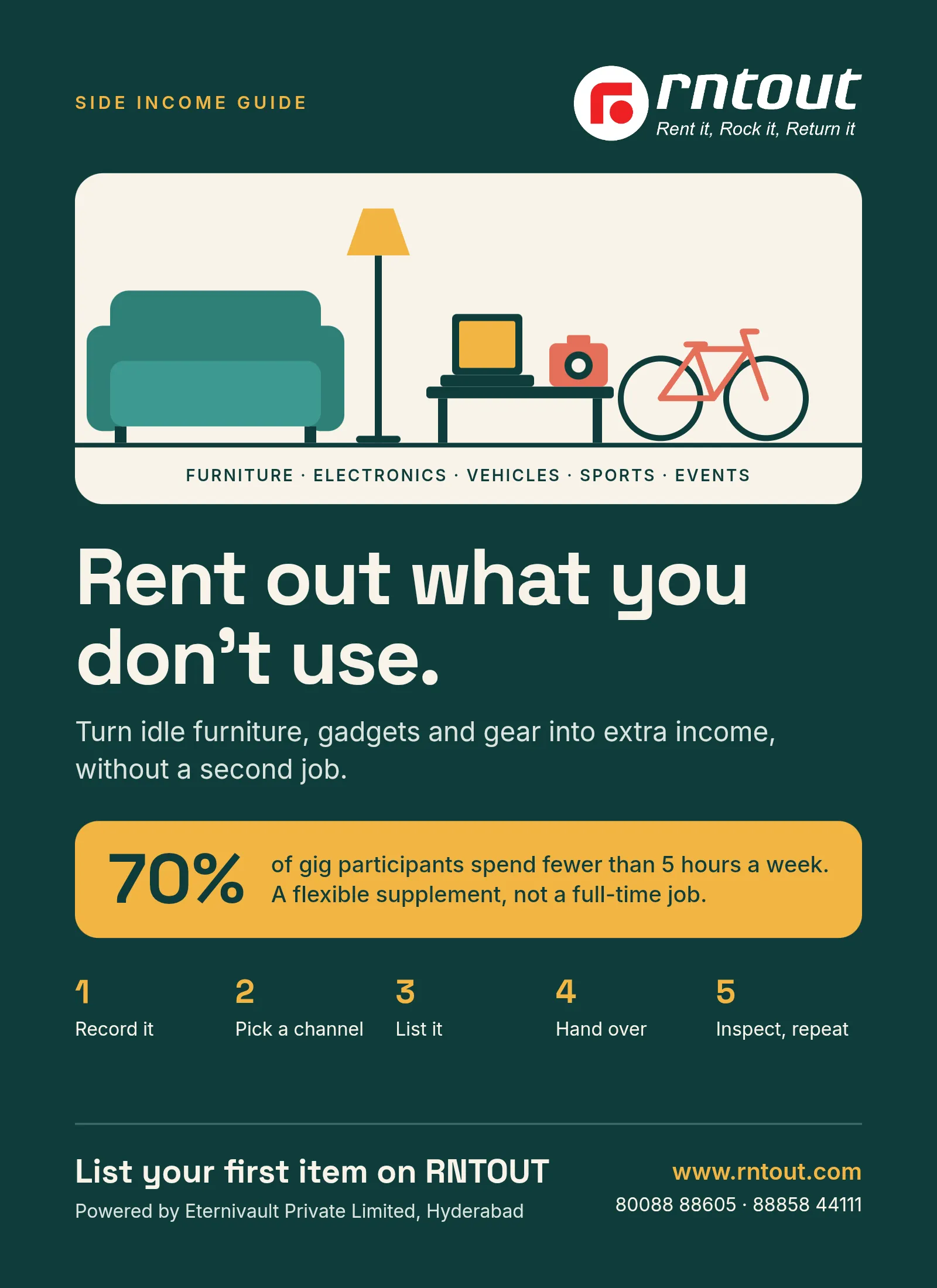
Learn how to rent out unused products and earn extra income. Get realistic returns, a step-by-step plan, listing tips, and safety advice for owners.

Glenford J. Myers initially introduced the separation of debugging from testing in 1979.[11] Although his attention was on breakage testing ("A successful test case is one that detects an as-yet undiscovered error."[11]: 16 ), it illustrated the desire of the software engineering community to separa

The Punchline Rent it. Use it. Return it. Repeat. When you rent, you’re not just saving money — you’re saving the planet. It’s a win for your wallet, a win for your lifestyle, and a win for the world
Never miss out on a deal or an update.